
Pakistan's Quiet Victory
As Trump celebrates the end of the Iran crisis, Islamabad has returned to a familiar role: the state everyone mistrusts, but still needs.

After forty declarations of the end of the US-Iran conflict, Trump has finally announced that the war with Iran is over. On his eightieth birthday, as blood was spilt on the Washington lawn and UFC 250 played out in a surreal spectacle before millions, Trump decreed—almost like a Roman emperor—that oil would flow again with the reopening of the Strait of Hormuz. Yet as Trump basked in glory, one country has emerged as the real winner and the quiet centre of the drama: Pakistan.
Some journalists, such as Christina Lamb, have described Pakistan’s renewed access to Washington as an extraordinary turnaround for a country long associated in Western political memory with the Taliban, al-Qaeda’s sanctuary, the Mumbai attacks, and the darker underside of the War on Terror. But that misses the deeper point. Pakistan has not reinvented itself. It has returned to one of its most reliable roles: the state everyone mistrusts, but still needs.
Pakistan’s role in the peace process is not a comeback but a continuation of a long-established foreign policy tradition. For decades, the Pakistani state has cultivated the habits of a country that survives by being useful to adversaries, friends and non-state actors simultaneously. It presents itself as a mediator, facilitator and indispensable interlocutor, while preserving relationships and pursuing policies that often appear mutually contradictory.
Recent allegations surrounding Iranian aircraft in Rawalpindi, and Islamabad’s insistence that it has acted throughout as an “impartial, constructive and responsible facilitator”, illustrate the dilemma. Even where Pakistan’s conduct is not necessarily duplicitous, it often appears ambiguous. Understanding that ambiguity is the key to understanding Pakistan’s role in the current crisis.
For decades, the Pakistani state has turned strategic vulnerability into diplomatic leverage. It has learned to operate in the space between great powers, regional rivals and militant movements, telling each side enough of what it wants to hear while preserving room for manoeuvre.
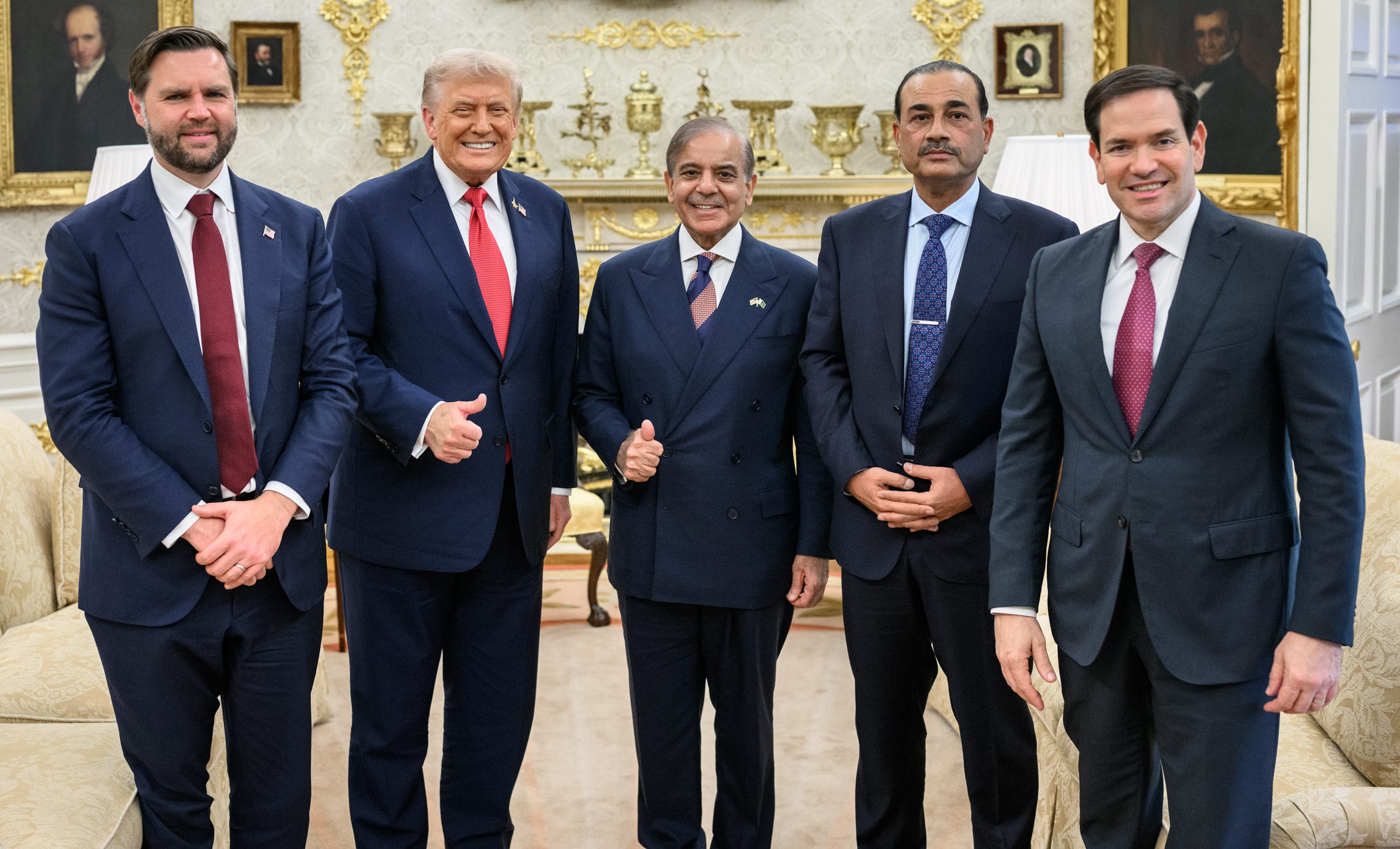
Today, Islamabad is performing that role with unusual confidence. Pakistan’s prime minister, Shehbaz Sharif, and its army chief, Field Marshal Asim Munir, have both been praised by Donald Trump. Munir has enjoyed a degree of access in Washington that is unusual for a serving Pakistani general; Trump reportedly has him on speed dial. At the same time, Pakistan remains deeply embedded in China’s strategic orbit. Pakistani and Chinese firms recently signed cooperation agreements worth more than $1 billion during Sharif’s visit to Hangzhou, while Islamabad has entered China’s domestic bond market through a yuan-denominated Panda Bond. China is also building Pakistan’s new Hangor-class submarine fleet, part of an eight-boat programme intended to strengthen Islamabad’s undersea capabilities vis-à-vis India.
Nor is China Pakistan’s only partner. Islamabad is exploring wider defence alignments with Saudi Arabia, Türkiye and Qatar. Turkish defence circles have discussed Pakistan’s possible role in the KAAN fifth-generation fighter programme, while officials have suggested that Ankara and Doha could eventually join Pakistan’s mutual defence cooperation pact with Riyadh.
Pakistan, in other words, is not merely mediating between Washington and Tehran. It is simultaneously deepening ties with Chinese finance, Chinese arms, Gulf security networks and Turkish defence technology. This is the contemporary face of an old strategy: not choosing a camp, but ensuring that every camp believes Pakistan is too useful to lose.
That, ultimately, is how Pakistan should be understood in the current peace process. The aircraft in Rawalpindi, the access in Washington, the investments from Beijing and the security ties stretching across the Gulf are not contradictions. They are different expressions of the same strategic logic. Pakistan’s greatest asset has never been military power or economic weight. It has been its ability to position itself at the intersection of competing interests, making itself indispensable.
While researching ‘Shadows over Kabul: An Insider Account of the Fall of the Afghan Republic’, written with Hamdullah Mohib, Afghanistan’s former ambassador to Washington and later national security adviser, I kept returning to a phrase he used to describe Pakistani statecraft: “whiskey diplomacy”. By that he meant the subtle art of ambiguity — a politics of cultivated civility, personal charm and strategic misdirection.
I had seen something of it myself. In Islamabad, one could sit at the Islamabad Club, where intelligence chiefs and army generals took breakfast, watched polo and hosted dinners worthy of any private members’ club in Mayfair. Conversation would move effortlessly from Islam to Ghalib to geopolitics. As the evening wore on, piety could give way to Scotch and cigars: “Bismillah, here you go.”
One diplomat described the experience to me with weary admiration: “You leave having enjoyed a wonderful evening, thinking you have achieved all your aims, when in reality you have achieved nothing.”
The same principle applies to Pakistan’s diplomacy. Washington, Beijing, Riyadh, Tehran and Ankara often leave their dealings with Islamabad believing they have secured a measure of Pakistani loyalty. Yet Pakistan’s skill lies not in choosing sides but in preserving ambiguity. Its greatest diplomatic success has been convincing multiple rivals that it remains indispensable to all of them, while remaining fully committed to none.
That is not merely a matter of style; it is deliberate, necessary and rooted in geography. Since Partition, Pakistan has lived with a profound sense of strategic exposure. Its major cities and political heartlands lie close to India, its principal rival. From Islamabad’s perspective, India is at best a competitor and at worst an existential threat. The result is a state whose civilian institutions often operate in the shadow of a security establishment that sees survival as the organising principle of national life. In other words, it is a garrison state.
That insecurity has shaped Pakistan’s behaviour for decades. If securing Pakistan required nuclear weapons, then so be it. If it required cultivating influence in Afghanistan to prevent a hostile government in Kabul, then so be it. If it required managing Washington while preserving ties with the Taliban, then so be it. And if today it requires presenting itself as a bridge between the United States and Iran while deepening ties with China and the Gulf, that too fits the pattern.
Afghanistan offers perhaps the clearest example of how this strategy works—and of its limits. Since the anti-Soviet jihad of the 1980s, Pakistan has sought to shape events across its western border in pursuit of strategic depth against India. When Afghanistan descended into civil war, Islamabad found in the Taliban a movement that promised order in Kabul on terms favourable to Pakistani interests.
After Sept. 11, Pakistan refined the balancing act. Publicly, it cooperated with Washington. Privately, it preserved the Taliban as a hedge against long-term American influence in Afghanistan. Mohib put it plainly to me: Pakistan “professed cooperation with Washington” while sheltering the Taliban. Ahmad Zia Seraj, the last intelligence chief of the Afghan republic, was blunter still. Pakistan allowed the Taliban leadership to retain “a safe place to sit down, plan and reorganise the group and come back.”
Washington knew this, yet Pakistan had made itself indispensable. American forces relied on Pakistani airspace and supply routes, while Pakistani officials simultaneously positioned themselves as essential diplomatic intermediaries between Washington, Kabul and the Taliban. As Mohib put it, Islamabad “maintained the theatre of engagement just enough to deflect international scrutiny”, buying time and managing appearances while the real decisions were being made elsewhere.
Yet it would be too simple to portray Pakistan as an omnipotent puppet master. Pakistan’s strength lies less in absolute control than in leverage, and leverage comes with risks. Recent tensions between Islamabad and the Taliban make that clear. Hassan Abbas, author of The Return of the Taliban , told me: “Pakistan was never in control of all the Taliban factions … control means significant influence … but the rest have their own agenda.” Ahmad Massoud, leader of the National Resistance Front, offered a similar assessment: “I believe that they do not have full control over it. Absolutely.”
That is the paradox of Pakistan’s statecraft. It can shape conditions, cultivate influence and steer events towards outcomes it broadly desires. But it cannot always control what follows. As Mohib put it to me: “When you breed snakes for your neighbours, eventually they bite you too.”
Pakistan’s power lies in its ability to insert itself into conflicts, cultivate relationships with opposing sides and make itself indispensable to diplomatic processes. Its currency is not trust but necessity. That can make Pakistan an effective intermediary. It can also, at least from a Western perspective, make it a dangerous one, especially when its own security interests are concealed behind the language of facilitation.
One should therefore view Pakistan’s role in the US-Iran crisis with neither naivety nor hysteria. Islamabad is not simply an honest broker, nor is it merely a rogue actor. It is a state pursuing its interests through ambiguity, leverage and managed instability—sometimes successfully, sometimes disastrously. Afghanistan demonstrated both the power and the limits of that approach. Pakistan helped shape the conditions that brought the Taliban back to Kabul, but it could not control what followed.
That is why Pakistan has emerged as the quiet winner of the current crisis. Not because it has resolved the rivalry between Washington and Tehran, but because it has once again made itself indispensable to both. For decades, Pakistan has survived by convincing competing powers that they cannot afford to ignore it. Today, as Trump declares victory and the guns fall silent, Islamabad has returned to a familiar role: the state everyone mistrusts, but still needs.
For those reading this as a forward, my name is Tam Hussein an award winning investigative journalist with a particular focus on conflict. The Blood Rep is my newsletter that covers security, jihadism, militancy, criminal networks and fiction. Do support my work by purchasing my books To The Mountains, The Travels of Ibn Fudayl, The Darkness Inside, A King Without A Crown and Shadows Over Kabul. An Insider’s Account of the Fall of the Afghan Republic.